
5 Exercises That Can Help With Lower Back Stiffness After Sitting All Day
If your lower back feels stiff after sitting at a desk all day, you probably don't need an overly complicated mobility routine.
For many people who spend most of the day sitting, a combination of core work, glute activation, and general movement can be a good place to start.
Five exercises I regularly use are the plank, side plank, bird dog, glute bridge, and dead bug. They require little to no equipment, train the muscles around the trunk and hips, and work well as a short warm-up before exercise.
Low back pain itself is extremely common. According to the World Health Organization, around 1 in 13 people worldwide experienced low back pain in 2020, and most people will experience it at some point in their lives.
That doesn't mean every stiff back is an injury.
If you sit for eight or more hours a day, don't get much physical activity, and occasionally notice that your hips or lower back feel stiff when you stand up, sometimes your body simply needs more movement.
As a personal trainer, these are five exercises I commonly use before workouts, especially after I've been sitting for a while.
Disclaimer: The information in this article is based on my personal experience and should not be taken as medical advice, injury rehab advice, or a recommendation for everyone. Every person’s body, injury history, and pain tolerance are different. What worked for me may not work for you. If you are dealing with knee pain, are unsure about what is causing it, or do not have experience modifying exercises safely, speak with your family doctor, physiotherapist, or another qualified healthcare professional before trying anything mentioned here.
Table of Contents
Why Can Your Lower Back Feel Stiff After Sitting?
Sitting isn't automatically bad for your back. The bigger issue is often how long you stay in one position and how little you move throughout the day.
Think about a typical workday. You sit at your desk for a few hours, get up for lunch, sit again, drive home, and then sit on the couch. That's a lot of time spent in roughly the same position.
Your hips haven't moved through much range of motion. Your glutes haven't had to produce much force. Your trunk hasn't had to stabilize your body very much.
When I have been sitting for a long period of time, I generally feel better once I start moving again. That's one reason I like using the following exercises as part of my warm-up.
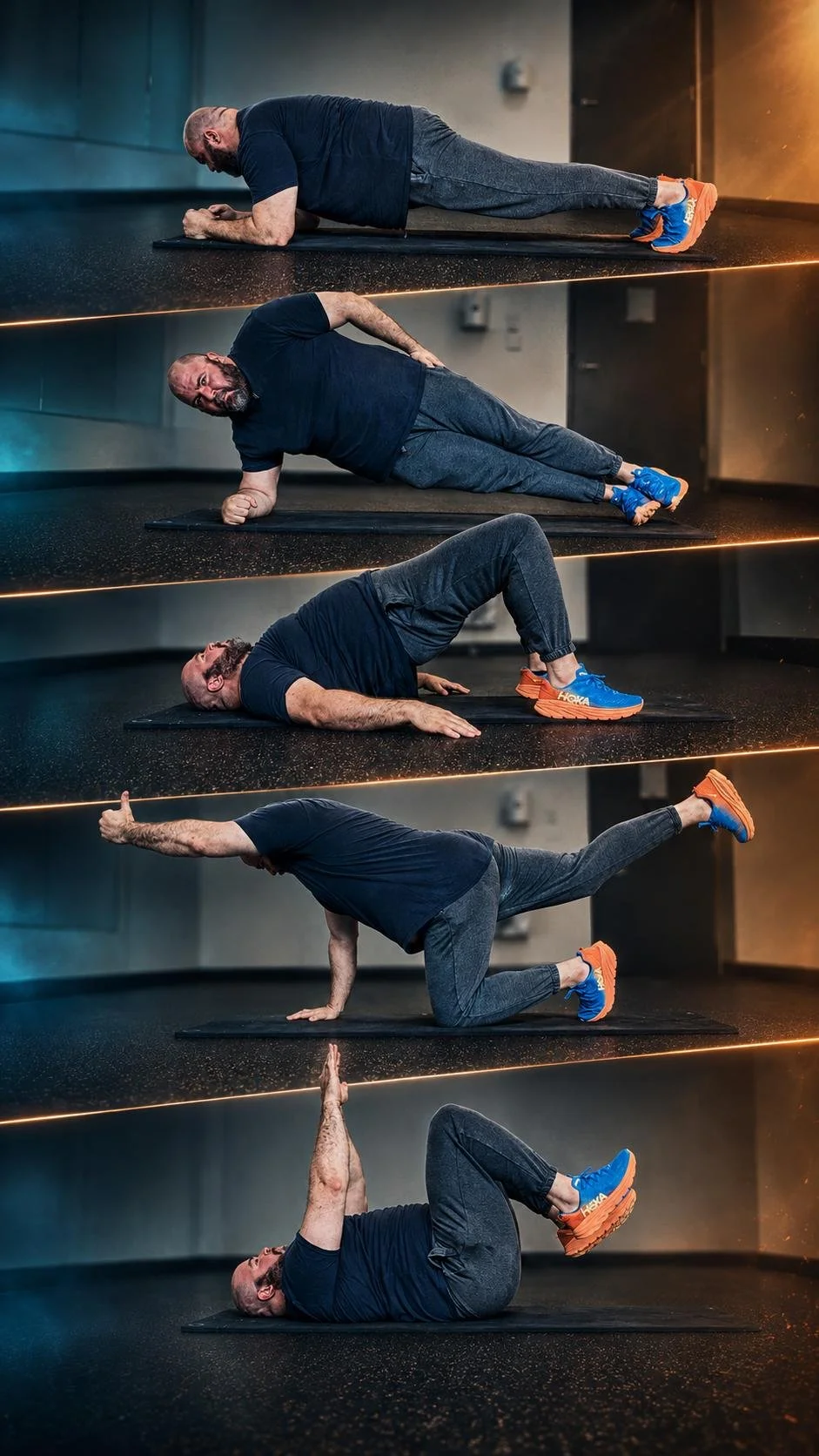
1. Plank
The plank is one of the most basic core exercises, but basic doesn't mean ineffective. Your abdominal muscles and the other muscles surrounding your trunk help stabilize your spine and pelvis while you walk, run, lift weights, and perform everyday movements.
How to Do a Plank
Place your forearms on the floor with your elbows underneath your shoulders.
Extend your legs behind you and lift your body from the floor.
Brace your stomach and squeeze your glutes while keeping your body relatively straight from your shoulders to your heels.
Don't worry about holding a plank for several minutes.
I'd much rather see someone perform a good 20-second plank than spend a minute hanging through their lower back.
Beginner recommendation: 1–3 sets of 10–60 seconds.
Start on the lower end and increase the duration as you get stronger.
2. Side Plank
The side plank targets your core from a different angle. It challenges muscles along the side of your trunk that help control and stabilize your pelvis and spine.
How to Do a Side Plank
Lie on your side with your elbow directly underneath your shoulder.
Keep your legs straight and either stack your feet or place one slightly in front of the other.
Push into the floor and lift your hips.
Your shoulders, hips, and legs should form a relatively straight line.
If the regular side plank is too difficult, bend your knees and perform the exercise from your knees instead.
Beginner recommendation: 1–3 sets of 10–30 seconds per side.
Don't be surprised if one side feels stronger than the other.
3. Bird Dog
The bird dog is probably one of the exercises I use most often in warm-ups. It teaches you to move your arms and legs while keeping your trunk relatively stable.
How to Do a Bird Dog
Start on your hands and knees.
Your hands should be underneath your shoulders and your knees underneath your hips.
Brace your core.
Reach one arm forward while extending the opposite leg behind you. For example, your right arm and left leg move at the same time.
Return to the starting position and switch sides.
The goal isn't to kick your leg as high as possible.
Keep your hips under control and focus on reaching long through your arm and leg.
Beginner recommendation: 3 sets of 10 repetitions per side.
Perform the repetitions slowly rather than rushing them.
4. Glute Bridge
After spending hours sitting, I like getting my glutes involved before moving into heavier exercises such as squats, deadlifts, or lunges. The glute bridge is one of the easiest ways to do that.
How to Do a Glute Bridge
Lie on your back with your knees bent and feet on the floor.
Brace your stomach slightly.
Push through your feet and squeeze your glutes as you raise your hips from the floor.
Pause briefly at the top and lower yourself back down.
You don't need to force your hips as high as possible.
If you feel yourself excessively arching your lower back, you've probably gone far enough.
Beginner recommendation: 3 sets of 10–20 repetitions.
Once regular glute bridges become easy, you can progress to single-leg or weighted variations.
5. Dead Bug
The dead bug is another exercise that looks much easier than it actually is when performed properly. It's especially useful for learning how to keep your trunk controlled while moving your arms and legs.
How to Do a Dead Bug
Lie on your back.
Bring your knees up so your hips and knees are bent to approximately 90 degrees, and point your arms toward the ceiling.
Brace your core.
Slowly extend one leg while lowering the opposite arm behind your head.
Return to the starting position and switch sides.
Only move as far as you can while maintaining control.
You don't need your hand or heel to touch the floor.
Beginner recommendation: 3 sets of 10 repetitions per side.
A Simple Lower Back and Core Routine After Sitting All Day
If you've spent most of your day at a desk, you can put all five exercises together into a short routine:
Plank: 10–60 seconds
Side Plank: 10–30 seconds per side
Bird Dog: 10 repetitions per side
Glute Bridge: 10–20 repetitions
Dead Bug: 10 repetitions per side
If you're a beginner, start with one round. As you become more comfortable with the exercises, work toward two or three rounds.
You can use the routine before strength training, after work, or simply as a way to get yourself moving after several hours at a desk.
Don't Forget the Simplest Exercise: Walking
Core exercises aren't a substitute for moving throughout the day. If you work at a desk, one of the easiest things you can do is simply get up more often.
Walk around the office. Take a short walk at lunch. Stand up between meetings. Change positions instead of staying in the same chair for four straight hours. It doesn't have to be complicated. Your body generally benefits from regularly changing positions and being exposed to different types of movement.
Will These Exercises Fix Lower Back Pain?
Not necessarily, and that's an important distinction. These exercises are intended for someone who is generally healthy but may experience occasional lower back stiffness after sitting or being sedentary.
They aren't a diagnosis or treatment for a back injury. Lower back pain can have many different causes, and two people experiencing pain in the same area may have completely different issues.
If you have severe back pain, pain following an injury, pain that continues to get worse, persistent symptoms, numbness, weakness, neurological symptoms, or pain that hasn't been properly assessed, speak with an appropriate qualified healthcare professional.
Don't assume you simply have a "weak core" and try to exercise through it.
Frequently Asked Questions
What are the best exercises for lower back stiffness from sitting?
For someone without a diagnosed injury, exercises such as planks, side planks, bird dogs, glute bridges, and dead bugs can help train the core and glutes while getting the body moving after prolonged sitting.
How often should I do these exercises?
They can generally be incorporated into a warm-up or short movement routine several times per week. Beginners can start with one set of each exercise and gradually increase volume based on how they respond.
Are planks good for your lower back?
Planks train the muscles surrounding the trunk without requiring repeated bending and extending of the spine. The key is maintaining good positioning and choosing a duration you can control.
Should I stretch my lower back after sitting all day?
Stretching may feel good for some people, but you don't necessarily need to aggressively stretch your lower back. Walking, changing positions, moving your hips, and performing controlled core and glute exercises can also be useful.