
Banded Ankle Dorsiflexion: How to Do It, Benefits & Mobility Tips
Table of Contents
What Is Banded Ankle Dorsiflexion?
Banded ankle dorsiflexion is a mobility exercise designed to improve the ankle’s ability to bend properly. More specifically, it helps with dorsiflexion, which is the motion of bringing your shin forward over your foot.
In this drill, a resistance band is anchored behind you and wrapped around the front of your ankle, just above the joint. As the band gently pulls backward, you drive your knee forward while keeping your heel down. This creates a mobilizing effect at the ankle and can help you move through the position more comfortably.
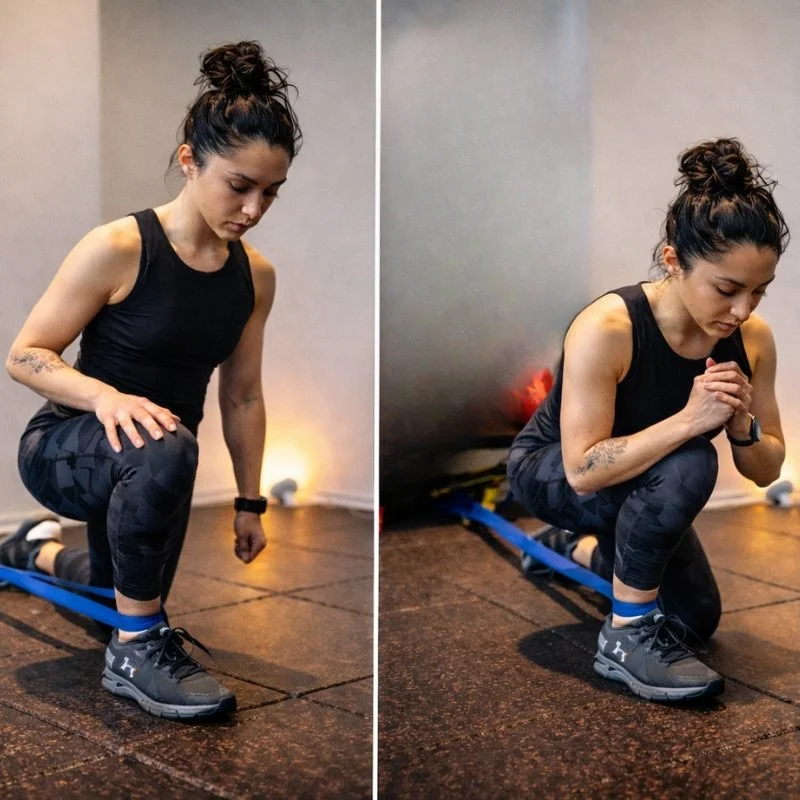
You can also try banded ankle distraction, since it works well alongside banded ankle dorsiflexion to improve ankle mobility, reduce stiffness, and strengthen the lower leg.
How to Do Banded Ankle Dorsiflexion
To perform this exercise, you will need a resistance band and something sturdy to anchor it to, such as a rack, heavy kettlebell, or secure door attachment.
Start by attaching the band to a stable object that will not move. Use a moderate resistance band so there is enough tension without making the movement too aggressive.
Step into the band and place it around your lower leg, just above the ankle joint on the shin area. From there, step back until you feel the band pulling your ankle backward.
Once you are in position, place the working foot flat on the floor. From here, slowly drive your knee forward while keeping your heel firmly planted. That is the key detail of the whole exercise. If the heel lifts, you are no longer getting the same ankle mobility benefit.
Begin with small movements rather than forcing a deep range right away. Push the knee forward a couple of inches, then return to the starting position. As the ankle loosens up, you can gradually move the knee farther forward while still keeping the heel down.
You can also explore slightly different knee angles. For example, you may drive the knee:
slightly toward the baby toe
straight forward
slightly toward the big toe
These changes should be subtle, not extreme. A slight adjustment in angle can help you explore the ankle from slightly different positions, but the movement should stay controlled and pain-free.
A good starting point is about 20 to 30 reps per side, or roughly 1 to 2 minutes per ankle.
Benefits of the Banded Ankle Dorsiflexion
The banded ankle dorsiflexion drill can be a great addition to a warm-up or mobility routine. Here are some of the main benefits.
1. Helps improve ankle mobility
The biggest benefit is right in the name. This drill helps improve dorsiflexion, which is one of the most important ankle motions for lower-body movement. Better ankle mobility can make everyday movement and exercise feel smoother.
2. May improve squat and lunge mechanics
Limited ankle mobility often shows up during exercises like squats, split squats, and lunges. If the ankle does not move well, the body may compensate elsewhere. Improving dorsiflexion can help you get into better positions with more control.
3. Encourages proper heel contact
One of the main coaching points in this movement is keeping the heel on the ground at all times. This helps reinforce better movement habits and prevents cheating through the drill.
4. Easy to adjust for different levels
You can start with a small range of motion and gradually work deeper as your ankle feels better. You can also change the band tension or the amount of time spent on each ankle.
5. Useful as part of a warm-up
Because it is simple and low impact, banded ankle dorsiflexion works well before leg workouts, athletic training, or even as a quick mobility drill during the day.
Important Tips to Keep in Mind
When doing this exercise, the most important rule is simple: keep the heel down. That is what makes the movement effective. Driving the knee forward while the heel lifts changes the drill and takes away from the ankle mobility focus.
You should also keep the movement controlled. There is no need to force the knee aggressively forward or swing side to side. Small, deliberate motion usually works best.
Finally, if you feel pain or pressure in the knee, ease off. The movement should feel gentle and controlled, not sharp or uncomfortable.